
Mingo County Civil Docket Searches
The Judiciary's Court Record Access page is the place to pick the right statewide system. WVPASS covers public Mingo County Circuit Court civil records. MCRSearch handles the smaller Magistrate Court civil claims along with landlord-tenant matters. Family Court files sit outside the ordinary civil stream. Probate belongs to the County Clerk.
Begin with the full party name, plus any civil action number from a notice. Work with the search fields WVPASS presents rather than guessing at requirements. The official Magistrate guide allows a first name, last name, or case number. It returns no more than 30 results at a time.
- Identify Circuit, Magistrate, Family, or County Clerk jurisdiction.
- Open WVPASS for Circuit civil or MCRSearch for Magistrate civil.
- Select Mingo County and use the live name or number fields.
- Compare case type, filing date, parties, and status.
- Give the clerk the number and exact filing or order needed.
Mingo Civil Courts Compared
Four offices split Mingo County's civil records. Circuit Court takes general civil, equity, writ, and appeal work. Magistrate Court hears the smaller civil claims and landlord-tenant disputes. Family Court handles domestic relations under tighter privacy rules. The County Clerk, meanwhile, holds probate, estate, land, and recorded documents rather than Circuit civil actions.
| Venue | Civil work | Custodian |
|---|---|---|
| Circuit Court | General civil, equity, writs, appeals | Lonnie Hannah, (304) 235-0320 |
| Magistrate Court | Smaller claims and landlord-tenant | Teresa L. Lackey, (304) 235-2445 |
| Family Court | Divorce, custody, support, paternity | Circuit Clerk public index/order route |
| County Clerk | Probate, estates, and land records | Larry Croaff, (304) 235-0330 |
Picking the wrong stream is the most common reason a docket search fails. Court-like papers do not turn a probate dispute into a WVPASS civil action. In the same way, a Family Court index can be public even while its pleadings and exhibits stay confidential.
Civil Dockets: What They Show
A Mingo County civil docket is the ordered history of the case. Official Mingo material lists the civil action number, case style, type, status, judges, filing events, referral dates, settings, deadlines, and later orders. An e-file stamp or transaction reference may appear too. Keep one distinction in mind. The docket entry names the activity; the filing or order holds the full text.
| Case number | A civil action identifier such as 21-C-11. |
|---|---|
| Parties | Plaintiff, defendant, petitioner, or respondent roles in the caption. |
| Filings | Complaint, answer, notices, motions, exhibits, and returns of service. |
| Settings | Pretrial, mediation, motion, trial, and other hearing dates. |
| Judgment | Final order, default, agreed judgment, dismissal, or post-judgment action. |
A status label never tells the whole story. Always read the dated order tied to that status. A pending motion has not been granted yet, and a trial date on the calendar can still be continued later. When legal effect matters, request the document behind the Mingo County docket entry itself.
Mingo Business Court Metadata
An official Mingo Business Court case page shows how much structured metadata a civil record can carry. The public fields run from Business Court Division case type and status to the referral decision date. You also get the BCD case number, the presiding judge, and the resolution judge. The Circuit Court judge appears too. So do the Circuit civil action number and the county.
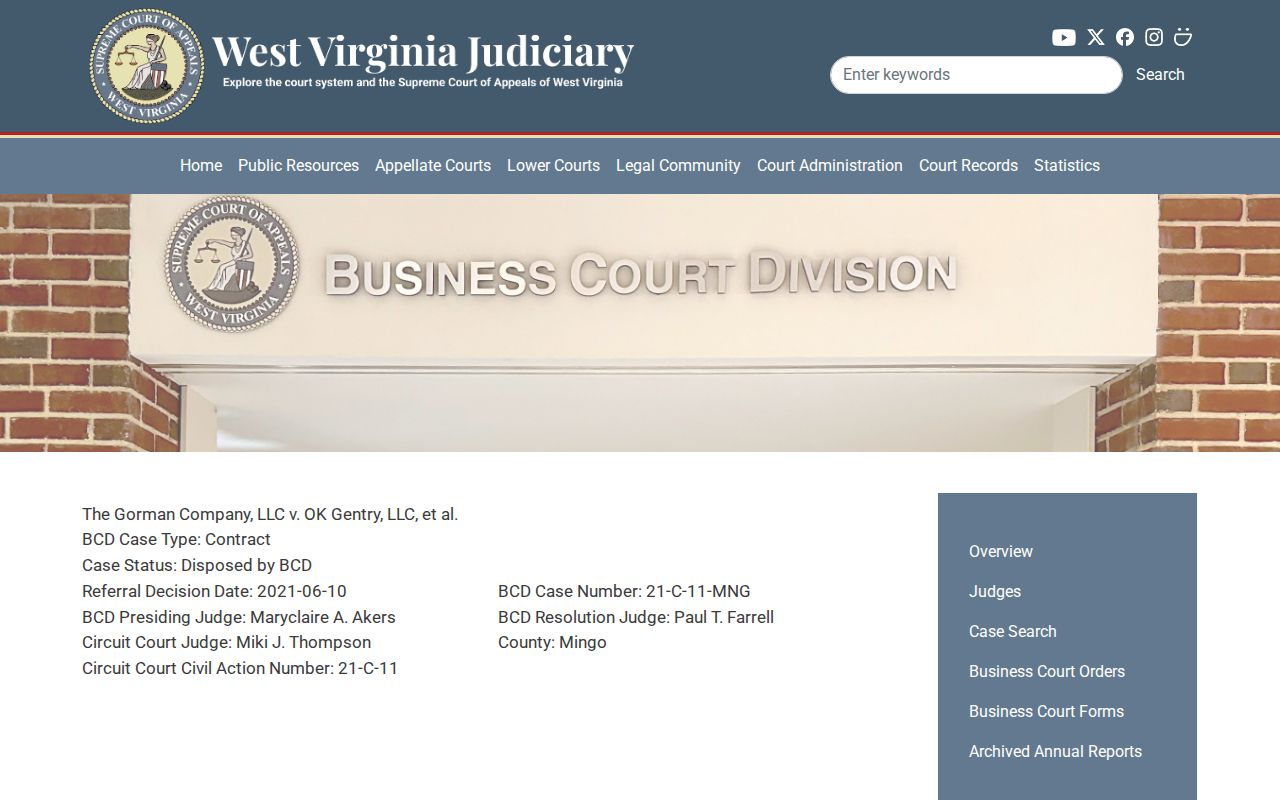
That official display helps you separate case metadata from the pleadings and orders behind it. A referral label or status is a navigation clue only. It cannot replace the source order. When you ask Lonnie Hannah's office for the Mingo County file, use the Circuit civil action number. That number pulls the right file.
What Cases Fill the Civil Docket
Court level shapes what fills a Mingo County civil docket. Circuit Court hears the higher-value civil actions, equity matters, extraordinary writs, and appeals. Magistrate Court carries smaller claims plus landlord-tenant matters. Family Court's domestic cases run under their own rules. County Clerk probate and land records form a separate stream entirely.
- General civil claims and equity actions in Circuit Court
- Extraordinary writ proceedings and lower-court appeals
- Smaller civil claims in Magistrate Court
- Landlord-tenant matters before a magistrate
- Domestic relations in Family Court under confidential-file rules
A Magistrate civil judgment can be appealed to Circuit Court within the official rule's 20-day period, subject to its exceptions and method of calculation. That appeal opens a Circuit path alongside the lower-court record. When you request papers, bring both case numbers you know.
Mingo Civil E-Filing History
Mingo County joined CourtPLUS and WV E-File on January 30, 2022. The system supports filing and case management for Circuit and Family Court. Its Vault serves as the digital repository. Circuit clerks scan paper-filed documents there. Statewide implementation reached every county by July 15, 2024.
CourtPLUS itself is not the public search screen. WVPASS is the public route. Registered attorneys, government users, and other permitted users file through E-File. An electronic order may carry an e-file stamp and reference code. The official Verify an Order tool can check that code.
Electronic filing has not erased paper either. The official FAQ says a document that must be sealed is paper-filed. It goes to the Circuit Clerk. Self-represented parties can still have paper needs. Older Mingo County civil records may call for local review, archive retrieval, or microfilm.
Hearings on the Civil Docket
An official Mingo scheduling order shows how civil dates fit together. Its setting block covers the trial date. It also lists the pretrial conference date and the jury or bench trial choice. Deadlines for memoranda, exhibits, witness lists, pending motions, instructions, and voir dire appear there too. Those dates organize preparation. A later signed order can change any of them.
The usual docket sequence is: Complaint or Petition › Service › Answer › Discovery › Motions › Scheduling Order › Pretrial or Mediation › Trial or Dispositive Hearing › Judgment › Post-Judgment Activity.
If a Mingo County civil date seems to move, check the newest docket event for a continuance or amended order. Then confirm the setting with the Circuit Clerk. The court posts no separate public daily-calendar portal for Mingo. The confirmation chain is practical. It runs through the online case record, the clerk's phone, the counter, and any clerk-office terminal.
Mingo Civil Outcomes in Plain Terms
What happens after a ruling matters just as much. A Mingo County court docket can keep moving with an appeal, an abstract of judgment, an execution, a suggestion, or a garnishment-related action. Each entry serves its own purpose, so read them as steps in enforcement or review rather than repeats of the same thing. Some track collection. Others open the path to a higher court.
- Judgment
- The court's formal ruling that resolves a claim.
- Default judgment
- A result after a party fails to defend, subject to notice and hearing rules.
- Agreed judgment
- A result accepted by the parties and entered by the court.
- Nonsuit
- The plaintiff ends the action under the applicable procedure.
- Dismissed
- The action ended without the requested judgment or under an approved resolution.
Mingo County publishes no official code list for every shorthand, DWOP included. Skip the guessing and read the order itself. Words on the page beat abbreviations. Also note that a notice of appeal and transfer can open a new docket at the reviewing court, so the paper trail does not end with the local file.
Mingo Civil Copies and Older Files
Start with WVPASS for any public Circuit document and MCRSearch for Magistrate case information. MCRSearch returns no images, though. For lower-court civil papers, Teresa Lackey's office has to supply them. Circuit copies work differently. Give Lonnie Hannah's office the case number and date. Name the exact complaint, motion, order, judgment, or docket sheet. Ask for that item.
Mingo County Circuit Clerk
78 East Second Avenue, Room 232
Williamson, WV 25661
(304) 235-0320
Mingo Magistrate Court Clerk
101 Logan Street, Room 303
Williamson, WV 25661
(304) 235-2445
If online options fail, visit the counter in person or use any public terminal there. A mailed or written request should spell out the court, action number, case style or party role, and filing year. It should also name the exact paper, your preferred format, and return details. Call first. The clerk publishes no local request form, email address, payment instruction, or turnaround promise. A quick phone call saves a round trip.
| Copy | Researched amount |
|---|---|
| Circuit plain copy sent out | $1 per page |
| Magistrate copy | 25 cents per page |
| Circuit abstract of judgment | $5 |
| Certified or exemplified copy | Ask the clerk for the current amount |
Who Can See Civil Dockets
Mingo County Circuit civil records are generally open. Anyone may inspect and copy them. A court can still limit access, but only by an order stating the nature, duration, and reason for the limit. Personal identifiers may be masked. Sealed portions, juvenile records, and domestic-violence data can stay outside ordinary public access.
Key Rules:
W. Va. Code § 51-4-2 permits court-record inspection and copies unless access is limited.
W. Va. Code § 29B-1-3 addresses reasonable inspection and copies from custodians.
Family Court Rule 6 keeps pleadings and exhibits confidential while generally allowing public orders and indices.
A civil case missing from online search can be newly filed, old, sealed, confidential, or misclassified. It can also sit in another record stream. Ask the clerk whether an index or order is public. Ask what process applies. Whatever appears online, the certified record held by the maintaining Mingo County clerk is the copy that counts.